


Next: Notable Homographic Transformations Up: World Coordinates and Camera Previous: Properties of the Rotation
We can use the rotation matrix and the pin-hole equation (9.25) to demonstrate some notable results.
From the system, we define the function  of
of
 in
in
 , called perspective mapping, as:
 |
(9.30) |
Every image contains 3 vanishing points, closely related to the choice of reference axes.
Consider, for example, the first axis. In our reference frame, coordinate  is the distance (the same reasoning applies to the other two coordinates).
Let this coordinate tend to infinity while keeping the others constant. The result is the point
is the distance (the same reasoning applies to the other two coordinates).
Let this coordinate tend to infinity while keeping the others constant. The result is the point
 |
(9.31) |
The same result can be obtained using homogeneous matrices, with a more compact formalism.
Taking the perspective transformation (9.24) and successively letting
 ,
,
 , and
, and
 tend to infinity, the image points (in homogeneous coordinates) obtained, representing the vanishing points in the three directions, are exactly the columns of matrix
![$[\mathbf{v}_x \mathbf{v}_y \mathbf{v}_z] = \mathbf{K} \cdot \mathbf{R}$](img1643.svg) , namely:
, namely:
 |
(9.32) |
 denotes the columns of matrix
  .
This is a first example of camera calibration based on knowledge of the image, namely the positions of the vanishing points.
.
This is a first example of camera calibration based on knowledge of the image, namely the positions of the vanishing points.
In particular, in the simplified case  ,
,  , and
, and  , the vanishing points are located at
 |
(9.33) |
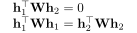
It should be noted that, since the 3 columns of are orthonormal, knowing 2 vanishing points is sufficient to always obtain the third (see the previous section).
If more than one variable is sent to infinity rather than just one, more than one point is obtained.
For  , but with
  , the vanishing point degenerates into a line whose equation is
 |
(9.34) |
Just as a point in the projected image degenerates into a line, a line with equation  becomes, in the projected image,

 |
(9.35) |