The previous sections presented examples of inverse perspective: the possibility of recovering a 3D point from a 2D image point and knowledge of a constraint in the world on whose surface the point lies.
It is always possible to define a system involving the optical ray (9.26) and a variety in  :
:
 |
(9.47) |
where
 has been defined.
The same formulation is used in computer graphics to denote RayTracing techniques.
Several cases are generalized in this section.
has been defined.
The same formulation is used in computer graphics to denote RayTracing techniques.
Several cases are generalized in this section.
A generic plane in written in the form
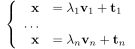 |
(9.48) |
provides a constraint that allows the intersection of the optical ray (9.26) with plane (9.48).
System (9.47) is linear and can be solved for  ; substituting into the first equation then determines the 3D point.
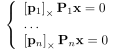
It is also possible to define a linear mapping associated with the line-plane intersection in the form
; substituting into the first equation then determines the 3D point.
It is also possible to define a linear mapping associated with the line-plane intersection in the form
 , having defined
 |
(9.49) |
The variety has equation
 |
(9.50) |
which, together with system (9.47), yields
 |
(9.51) |
The quadratic equation may therefore have 0 roots (no intersection), 1 root (the optical ray is tangent to the sphere), or 2 roots (the optical ray intersects the sphere).
Subsections
Paolo medici
2026-10-01


