Next: Planes Up: Lines, Planes, and Hyperplanes Previous: Distance Between Lines in
The lines considered so far tend to have an overparameterized representation relative to their degrees of freedom.
A line in the plane  has only 2 degrees of freedom, whereas a line written in implicit form depends on 3 parameters, known only up to a multiplicative factor and without a clear geometric meaning.
On the other hand, the explicit equation of a line with two parameters
has only 2 degrees of freedom, whereas a line written in implicit form depends on 3 parameters, known only up to a multiplicative factor and without a clear geometric meaning.
On the other hand, the explicit equation of a line with two parameters  has a singularity for vertical lines.
One solution to this problem is to change the parameterization and use polar coordinates.
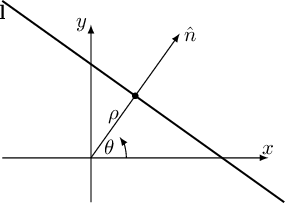
Using polar coordinates, it is possible to express a line in a two-dimensional space without singularities and using only 2 parameters:
 is the distance between the line and the point
  , and
, and  is the angle formed by this distance segment (orthogonal to the line) and the x-axis (Figure 1.4).
This representation should be compared with that given by equation (1.85).
Under this formulation, the relationship between these two parameters and the equation of the line becomes nonlinear.
is the angle formed by this distance segment (orthogonal to the line) and the x-axis (Figure 1.4).
This representation should be compared with that given by equation (1.85).
Under this formulation, the relationship between these two parameters and the equation of the line becomes nonlinear.
This equation is commonly used in the Hough transform for lines (Section 4.11) to exploit a bounded two-dimensional parameter space.
With this particular form, the distance between a point in space  and the line can be written compactly as
Paolo medici