


Next: Line in Polar Coordinates Up: Lines, Planes, and Hyperplanes Previous: Duality Principle
 R3
R3
In space , and in general in all higher-dimensional spaces, two lines  and
and  may not intersect at any point even if they are not parallel.
Such lines are called skew lines.
For these particular lines, a quantity of interest is their minimum distance and, consequently, the points on the two lines that realize this minimum.
may not intersect at any point even if they are not parallel.
Such lines are called skew lines.
For these particular lines, a quantity of interest is their minimum distance and, consequently, the points on the two lines that realize this minimum.
Consider two lines consisting of points  and
and  with equations
 and
and  are two arbitrary points belonging to the lines,
  and
and  are the direction vectors, and
 are scalar values that are unknowns of the problem.
The “distance” between two arbitrary points on the two lines is
 |
(1.78) |
 has been defined.
The quantity to be minimized is
has been defined.
The quantity to be minimized is
 , a function of
  and
and  , whose gradient vanishes at
 |
(1.79) |
and that can be solved easily; using this solution, the two closest points and can be obtained.
There is also an alternative to solving the linear system that reaches the same result through purely geometric considerations.
It can be shown that the distance between the two lines in is
 |
(1.80) |
 has been defined.
The vector
has been defined.
The vector  , obtained by the cross product, is by definition orthogonal to both lines, and the distance is the projection of the segment
 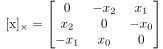 along this vector.
It is clear that when the lines are parallel (
along this vector.
It is clear that when the lines are parallel (
 ), it is not possible to determine a meaningful triangulation value.
The plane formed by translating the second line along intersects the first line at the point of minimum distance
 |
(1.81) |
Regardless of the chosen formalism, substituting these values into equations 1.77 yields the three-dimensional coordinates of the closest points on the lines.
Paolo medici
