Next: Plane Partitioning Up: Lines, Planes, and Hyperplanes Previous: Line in Polar Coordinates
The discussion of lines can be generalized to planes and hyperplanes in space
 .
As with lines, an implicit homogeneous form of the equation of a plane exists, understood as the locus of points expressed by the homogeneous coordinate
.
As with lines, an implicit homogeneous form of the equation of a plane exists, understood as the locus of points expressed by the homogeneous coordinate
 with respect to
 :
:
 |
(1.84) |
Homogeneous coordinates are defined only up to a multiplicative factor, and it is therefore possible to impose an optional constraint: as for lines, the first 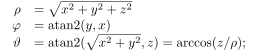 parameters of the homogeneous coordinate may be regarded as forming a unit-length vector.
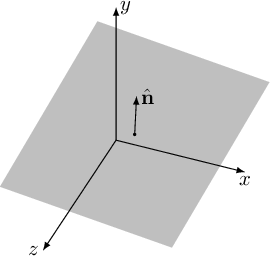
A generic plane, or hyperplane, is therefore the locus of points
satisfying the condition
 is the normal to the plane and
  if and only if the plane passes through the origin.
In the case of
if and only if the plane passes through the origin.
In the case of  , an alternative representation of the plane is
 a generic point on the plane, from which the correspondence
 can be derived.
It should be remembered that the degrees of freedom are always exactly .
When introduced, the normalization constraint
 represents a special case: under this condition, as in the case of lines,
  represents the minimum Euclidean distance between the plane and the origin.
If the plane (or hyperplane) is normalized, the distance between a generic point  and the plane is measured as
 .
.
The point  closest to a generic point belonging to the hyperplane lies at the intersection of the direction line
  passing through and the plane itself:
 |
(1.89) |
As for the various generation methods, Section 4.6.3 will show how to obtain the least-squares regression of a set of points onto the equation of a plane.
As in the case of a line, the parameters of a plane in  can also be expressed using 3 polar coordinates (azimuth, zenith, and ):
Paolo medici