Next: Essential and Fundamental Matrices Up: Three-Dimensional Reconstruction Previous: Three-Dimensional Reconstruction and Homography
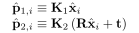
Consider the particular case in which the cameras are aligned with the axes, have identical intrinsic parameters, zero relative rotation, and are tilted by the pitch angle with respect to the plane  .
.
Under these conditions, the projection matrix is simplified slightly and takes the form
 .
.
The horizontal coordinate  of a generic point
  in world coordinates is therefore
Under the rectified-camera assumptions introduced above, namely identical orientations and intrinsic parameters—a condition that can always be achieved through rectification or by considering suitable image rows—the projective matrix (10.27) is the same in the two different reference frames. From equation (10.28), the only difference between the cameras is therefore in the numerator, due to the different positions of the pin-hole along the  axis.
It follows that the difference between the coordinates in the two images
axis.
It follows that the difference between the coordinates in the two images  (the disparity) is
 has been defined again.
Using relation (10.28) in equation (10.29) yields the notable result
has been defined again.
Using relation (10.28) in equation (10.29) yields the notable result
 |
(10.30) |
of the point is finally obtained:
 |
(10.31) |
is  .
.
The coordinate  of the point can instead be written as
Thus, the system of equations is
 |
(10.34) |
A particular disparity case arises when observing a plane, namely the ground plane, which accounts for most of the points in the image.
When the baseline lies along the axis, the disparity of the plane is a function only of , and this equation is that of a straight line.
The relationship between disparity and coordinate can be derived from the value of  in the second equation and by substituting it into the first of equations (10.33):
From the first of equations (10.35), it can be seen that the disparity depends only on the distance when the height  is fixed (for example, on the ground),
while the second shows that the disparity
is fixed (for example, on the ground),
while the second shows that the disparity  grows linearly with coordinate , with the known slope
 |
(10.36) |
 (square pixels).
The zero-disparity point
(square pixels).
The zero-disparity point  mentioned above is located at
 |
(10.37) |