


Next: Uncertainty Propagation Up: Elements of Probability and Previous: Standard Score
One of the fundamental problems in statistics is understanding how a random variable propagates through a complex system and to what extent it makes the system's output random.
Let  be a function that transforms the random variable
  into the random variable
  , that is,
  , with
  realizations of the random variable , and suppose that
  is invertible, meaning that there exists a function
  such that
  .
.
Let  be a generic interval in the domain of the values and let
 be its corresponding image.
It is clear that the probabilities of the events in and
be its corresponding image.
It is clear that the probabilities of the events in and 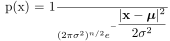 in
in 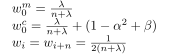 must be equal, namely,
Without loss of generality, the interval can be made infinitesimal. Under this condition, relation (2.25) becomes
Paolo medici


