


Next: Local Binary Pattern (LBP) Up: Binary Descriptors Previous: Binary Descriptors
|
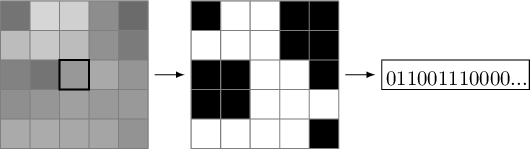
The Census transform (Census-Transformation) (ZW94) describes the portion of an image surrounding a point using a bit string.
For each image pixel, the surrounding area, with fixed size and shape, is analyzed in an ordered manner, and each pixel in this area is compared with the generating pixel.
If the pixel has a higher gray-level intensity, it is assigned bit 1; if it has a lower intensity, it is assigned bit 0:
 |
(7.3) |
By scanning the area in an ordered manner, a binary string can be generated.
An example of the Census transform applied to an area  is shown in Figure 7.4: this area produces a binary string of 25-1 bits (the central pixel is effectively irrelevant).
The Census transform reveals its potential in comparisons: rather than comparing two generic points using the SAD of the surrounding area, the points are compared using the Hamming distance between the respective binary strings of their Census transforms.
By constructing the binary string using gray-level differences, the Census transform is reasonably invariant to brightness.
Paolo medici