Next: Stereographic Projection Up: Alternative Parameterizations in Spaces Previous: Alternative Parameterizations in Spaces
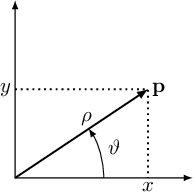
Assuming Cartesian coordinates as known, this section introduces polar coordinates and, in particular, presents the relations linking Cartesian and polar coordinates.
For a point in two-dimensional space, the relation linking these two coordinate systems is written as:
 |
(1.52) |
The inverse transformation, from Cartesian to polar coordinates, is
 |
(1.53) |
A point on a sphere, however, does not have a unique representation: for the same reason, as will be emphasized several times in the appendix, there are infinitely many representations of a rotation in three-dimensional space.
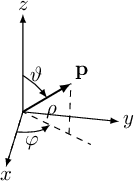
A common choice is spherical polar coordinates (spherical coordinate system).
With this convention, the relation between Cartesian and polar coordinates is written as
 is defined as the zenith, while
  is called the azimuth.
The inverse transformation, from Cartesian to polar coordinates, is obtained as
 |
(1.55) |