Next: Homogeneous Coordinates Up: Alternative Parameterizations in Spaces Previous: Polar Coordinates
A fairly common alternative for parameterizing the sphere  is to use stereographic projection to transform coordinates from the manifold space
 (parameter space) to
 (Cartesian space), and vice versa.
On the three-dimensional sphere  , it is possible to define a function
  as a stereographic projection from
![$U_{+3} := S^2 /\ \left[0,0,1\right]^{\top}$](img161.svg) to
to
 :
:
 |
(1.56) |
![\begin{displaymath}
\varphi_{+3}^{-1} \left( \left[u,v \right]^{\top} \right) =...
... \begin{bmatrix}
2u \\
2v \\
-1 + u^2 + v^2
\end{bmatrix}\end{displaymath}](img164.svg) |
(1.57) |
![$\left[0,0,1\right]^{\top}$](img165.svg) denotes the “north pole” of the sphere.
and
denotes the “north pole” of the sphere.
and
 are continuous on
  and therefore the stereographic projection is a homeomorphism.
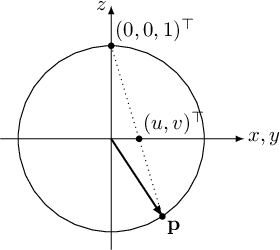
This projection establishes a relation between the point
and therefore the stereographic projection is a homeomorphism.
This projection establishes a relation between the point  on the plane
  and the point on the sphere
  , given by the intersection between the projection ray joining the origin
 (the only singular point) to the point on the plane and the unit-radius sphere, as shown in Figure 1.3.
Similarly, spaces
 can be defined in which the
  are unit vectors, within which six similar parameterizations can be defined (each with its own singularity). This makes it possible to choose the most appropriate parameterization so as to operate at the point farthest from the singularity of that particular formula.