


Next: Polar Coordinates Up: Elements Previous: Eigenvalues and Eigenvectors
Points in the various spaces  can be described using coordinates other than Cartesian coordinates. This section presents several useful parameterizations that will be used throughout the rest of the book.
We introduce the following definition:
 is the unit sphere in
 such that:
 |
(1.51) |
has  components and only one constraint, by definition it must have
  degrees of freedom (DOF).
In the case  , the unit “sphere”
 consists of only two points and is therefore not a connected manifold.
With  , the manifold is exactly the same as
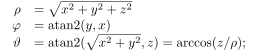
  , namely, with the parameterization
 .
.
The sphere  (the surface of a sphere or a direction in
  ), on the other hand, is a 2-manifold that does not have a group structure. It can be parameterized by two parameters (for example, polar coordinates, as we will see shortly), but it will always exhibit singularities.
The spheres  and the rotation groups
  are examples of differentiable manifolds that will be used extensively to represent orientations and geometric poses.