


Next: Descriptors Up: Keypoints Previous: SURF
The last class of keypoint extractors falls under the name Accelerated Segment Test, developed by Rosten. There are currently three slightly different versions of this algorithm.
|
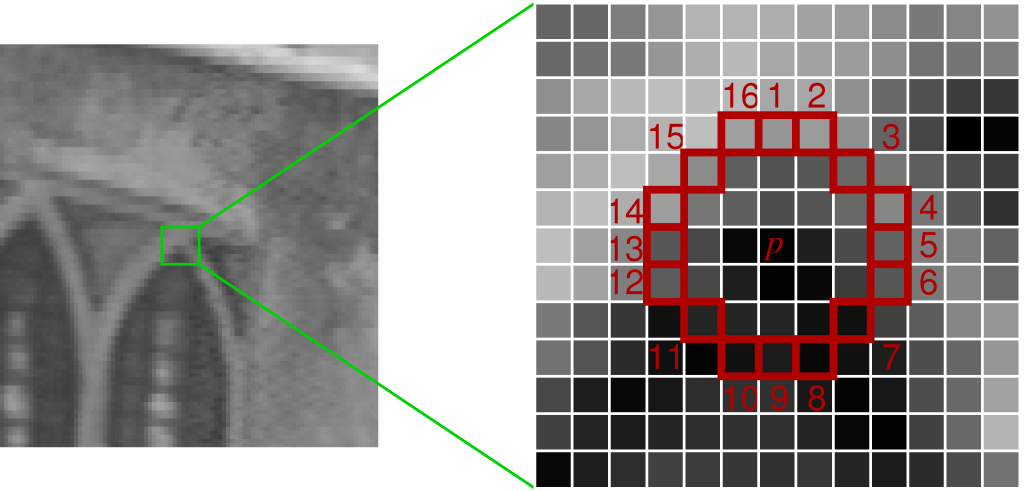
The first version of Features from Accelerated Segment Test FAST (RD05) is probably the most intuitive: in this case, points are considered distinctive if they have a continuous sequence of 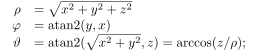 pixels along a circle of a given radius, all brighter (or darker) than the central pixel used as the gray-level reference.
For example, in FAST-9, the 16 pixels on the circle of radius 3 are analyzed, and it is checked whether 9 contiguous pixels are all above or all below a certain threshold relative to the central pixel.
In later versions (RD06), extraction is optimized using decision trees trained to identify distinctive points that maximize the local amount of information. These trees always process the pixels on the circle.
pixels along a circle of a given radius, all brighter (or darker) than the central pixel used as the gray-level reference.
For example, in FAST-9, the 16 pixels on the circle of radius 3 are analyzed, and it is checked whether 9 contiguous pixels are all above or all below a certain threshold relative to the central pixel.
In later versions (RD06), extraction is optimized using decision trees trained to identify distinctive points that maximize the local amount of information. These trees always process the pixels on the circle.
This approach is typical of recent years, when the abundance of public datasets has enabled widespread use of classifiers to construct stable feature-point detectors. In fact, given primitives that describe the neighborhood of a point, an optimization technique can be used to identify those that exhibit greater stability for the specific task. Rosten's paper also provides an excellent survey of previous feature-point extraction techniques.
In the final variant, FAST-ER, the area to be analyzed is extended beyond the points on a circle to include all pixels in the neighborhood of the central point.
Paolo medici