The MOB-LAB Project
The Italian PROMETHEUS Research Team working on PRO-ART and PRO-CHIP Projects presents MOB-LAB, a MOBile LABoratory suited to develop and test real time intelligent systems, monitoring the trajectory of a vehicle running on extraurban roads, by means of computer vision systems.
A few images of the MOB-LAB vehicle are available thanks to the courtesy of Jose Pettiti (CSTV - Torino)

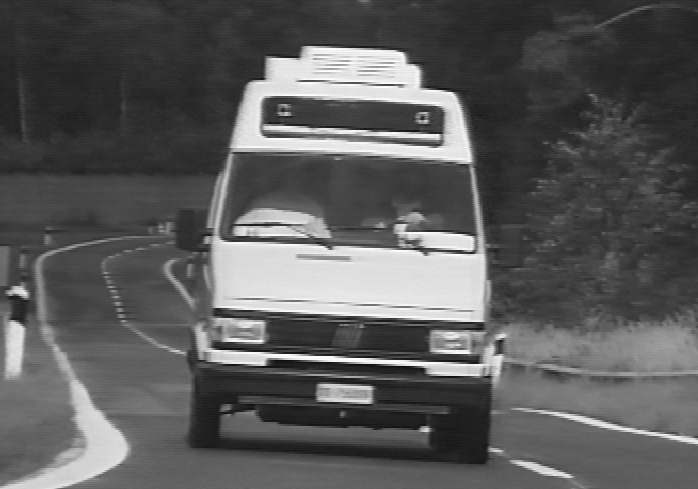
VEHICLE:
- FIAT Ducato 18 Maxi
EQUIPMENT:
- B/W and Color TV cameras in the front and the back of the vehicle to analyze the external environment.
- One millimeter-wave radar on the right side of the vehicle to monitor the right side of the road.
- Four sensors on board to measure the longitudinal and transverse components of the acceleration.
- Two real time digital image processors with a different architecture used to analyze images at a rate of about 1 image every 200ms.
- Two PC to analyze data coming from the radar and the other sensors.
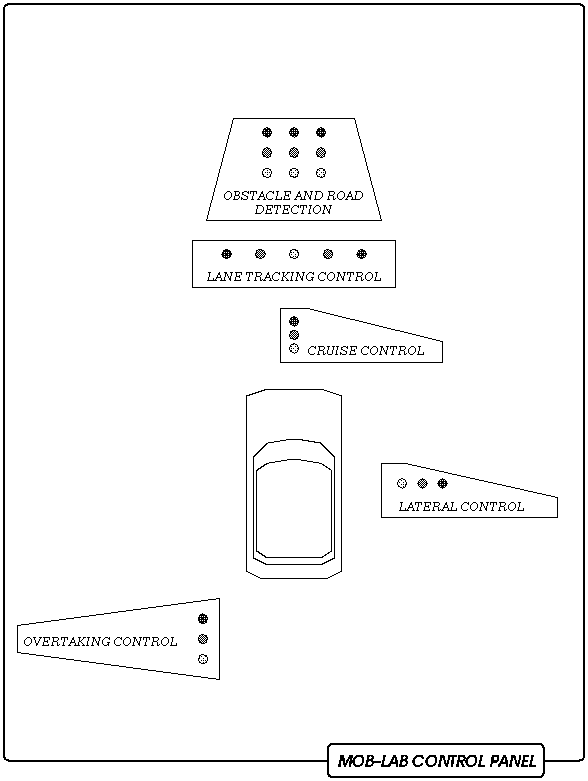
- A control panel to alert the driver.
FUNCTIONS:
- Obstacle and Road Detection. Road following and obstacle detection in front of the vehicle are performed by means of a real time vision system integrating techniques based on visual saliency with depth cues obtained by stereometry and a-priori knowledge of the road environment. The environment around the vehicle and the dangerous situations are summarized by means of nine leds of different colors. This function has been realized by the two Pro-Art research units of Turin: Istituto Elettrotecnico Nazionale "G.Ferraris" and Centro Studi per la Televisione of the CNR.
- Lane Tracking Control. Lane tracking is performed through the analysis of data coming from a TV camera and interpreted by means of a special purpouse massively parallel architecture for real-time image analysis, PAPRICA. The result of the analysis is presented to the driver through a set of five leds of different colors. More precisely the leds provide a visual warning to the driver when the car approaches the lane borders, becoming more evident when more dangerous positions are taken. This function has been realized by the Pro-Art research unit of the University of Parma, using the low-cost massively parallel board developed by the Pro-Chip research unit of the Politecnico of Turin and of the University of Parma.
- Cruise Control. This function is to estimate the security distance from the in-front vehicle by means of data acquired through a TV camera. The three leds in the control panel tell the driver the current position of the in- front vehicle: no light on for no vehicle; green for a vehicle at a security distance; yellow for warning; red for danger. This function has been realized by the Pro-Art research unit of the University of Genoa.
- Lateral Control. The lateral position of the vehicle with respect to a reference line (guard rail or continuous lateral emergency line), is detected by means of a millimeter-wave radar mounted on the dashboard. The detection of the reference line is made possible by positioning electromagnetic reflectors along the reference line. The data coming from the radar, fused with the information on the speed of the vehicle, are interpreted in order to assist the driver in preventing the vehicle from going off the road, and presented to the driver by means of three leds of different colors. This function has been realized by the Pro-Chip research unit Centro Studi Propagazione ed Antenne of the CNR.
- Overtaking Control. This funtions is to alert the driver during an overtaking manoeuvre if another vehicle is coming from the back. The detection of the incoming vehicle is performed by processing the images acquired from a TV camera looking outside the vehicle from the back glass. The leds in the control panel tell the driver the current position of the overtaking vehicle: green for no vehicles on the back; yellow if a vehicle is present on the back; red if a vehicle has initiated an overtaking manoeuvre. This function has been realized by the Pro-Art research unit of the University of Genoa.
- Car attitude Control. Different low-cost sensors inside the vehicle measure the longitudinal and trasversal components of the acceleration. Data coming from the sensors are interpreted and presented to the driver by means of visual information and alarms (to be specified). The sensors have been designed and manufactured by the Pro- Chip research units of the University of Brescia and of the University of Modena .
RESULTS:
The system shows the results of different approaches of computer vision techniques to alert the driver in dangerous situations. The MOB-LAB vehicle has been demonstrated at the BMM ( Board Member Meeting) in Paris, October 1994.
Project Coordinator
Prof. Giovanni Adorni, Department of Computer Engineering - University of Parma, Viale delle Scienze - 43100 Parma - ITALYPRO-ART Research Units:
- Department of Communication, Computer and System Science - University of Genova, Prof. Aldo Grattarola and Dr. Massimo Tistarelli
- Department of Computer Engineering - University of Parma, Prof. Giovanni Adorni
- Istituto Elettrotecnico Nazionale "G. Ferraris" - Torino, Dr. Giorgio Quaglia
- Centro Studi per la Televisione - CNR - Torino, Dr. Paolo Grattoni
PRO-CHIP Research Units:
- Department of Electronics - University of Brescia, Prof. Andrea Taroni
- Department of Physics - University of Modena, Prof. Bruno Morten
- Department of Computer Engineering - University of Parma , Prof. Gianni Conte
- Centro Studi Propagazione ed Antenne - CNR - Torino, Dr. Corrado Cugiani
- Department of Electronics - Politecnico di Torino, Prof. Francesco Gregoretti