


Next: Regression and Optimization Methods Up: State Estimation and Bayesian Previous: Parameter Estimation
The alpha-beta filter can be viewed as a simplified version of the Kalman filter in which the state is represented by only two variables, one of which is the integral of the other.
By analogy with physical systems, these variables can be called position  and velocity
  .
If the velocity is assumed to remain constant over the short time interval
.
If the velocity is assumed to remain constant over the short time interval  , the a priori estimate (prediction) of the position at time
  is
is
 |
(3.52) |
 |
(3.53) |
The output is nevertheless affected by noise, and the observed value 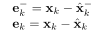 differs from the predicted value
 .
This prediction error
.
This prediction error  is called the innovation:
 |
(3.54) |
We define two parameters  and
and  in order to obtain the a posteriori estimate as
 |
(3.55) |
This yields an asymptotic observer for the position and velocity variables.
Unlike the Kalman filter, the alpha-beta filter is a suboptimal filter whose parameters and are tuned experimentally, without any statistical basis.
This approach is usually justified by the fact that, even for the Kalman filter, the noise matrices sometimes have to be specified entirely empirically.