Next: BRIEF Up: Binary Descriptors Previous: Census Transform
In its original version (OPM02), LBP was indistinguishable from the Census transform applied to a  window: for each image point, the 8 neighboring pixels are thresholded against the central pixel to produce an 8-bit string, which is equivalent to an integer descriptor between 0 and 255.
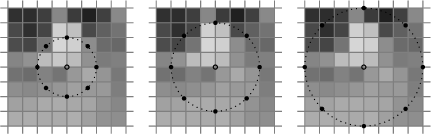
This original concept was later extended to  points along a circle of radius
  centered on the pixel whose feature is being computed (Figure 7.5).
Since the points on the circle do not usually coincide exactly with image pixels, bilinear interpolation can be used to estimate the values to be thresholded when constructing the binary string.
centered on the pixel whose feature is being computed (Figure 7.5).
Since the points on the circle do not usually coincide exactly with image pixels, bilinear interpolation can be used to estimate the values to be thresholded when constructing the binary string.
The LBP operator produces  possible values for each image point.
When the image is rotated, the pixel values move along the circle, causing the bits in the binary string to rotate as well.
A rotation-invariant LBP operator can be obtained by normalizing the string using a suitable transformation.
For example, one such transformation is to perform rotations of the binary string and select the result with the smallest value:
possible values for each image point.
When the image is rotated, the pixel values move along the circle, causing the bits in the binary string to rotate as well.
A rotation-invariant LBP operator can be obtained by normalizing the string using a suitable transformation.
For example, one such transformation is to perform rotations of the binary string and select the result with the smallest value:
![\begin{displaymath}
\text{LBP}_{r.i.} = \min_i \text{ROR}_i ( \text{LBP} ) \quad i \in [0, n-1]
\end{displaymath}](img1541.svg) |
(7.4) |
Paolo medici