


Next: Local Binary Pattern (LBP) Up: Binary Descriptors Previous: Binary Descriptors
|
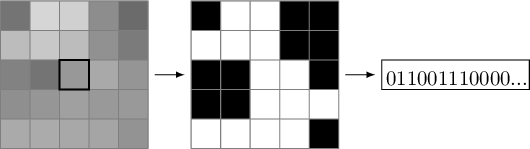
The Census transform (Census-Transformation) (ZW94) represents an image region around a point as a bit string.
For each image pixel, the surrounding region, whose shape and size are fixed, is scanned in a prescribed order, and each pixel in the region is compared with the center pixel.
If a pixel has a higher gray-level intensity, it is assigned a 1; otherwise, it is assigned a 0:
 |
(7.3) |
Scanning the region in order produces a binary string.
Figure 7.4 shows an example of the Census transform applied to a  region: it produces a binary string of 25-1 bits (the central pixel does not affect the result).
The Census transform is useful for comparisons: rather than comparing two arbitrary points using SAD over their surrounding regions, the points are compared using the Hamming distance between their respective Census-transformed binary strings.
Because it constructs a binary string using differences in gray level, the Census transform is fairly invariant to brightness.
Paolo medici