


Next: Binary Descriptors Up: Descriptors Previous: Histogram of Oriented Gradients

|
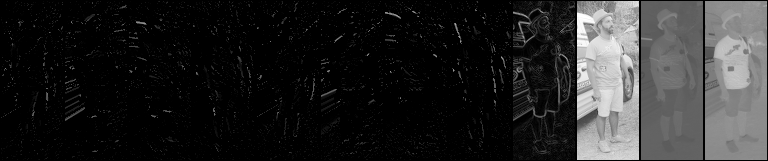
HOG variants use cells of different shapes, and it was discovered that the integral image could also be used to speed up the computation of the gradient magnitude histogram. Thus, at the intersection of HOG and Haar features, Integral Channel Features have recently demonstrated promising performance; they are effectively a generalization of HOG that uses the integral image.
The feature values are obtained by summing regions not directly from the original image, but from different secondary images produced by nonlinear processing of the region being characterized. Common processing operations include the gradient phase channels used in HOG, the gradient magnitude image, the grayscale image itself and, if available, two additional channels representing chrominance. The gradient is often computed using Sobel, but experiments show that the simple derivative filter also produces satisfactory results. Here too, the Sobel phase can be used with or without its sign, depending on the application.
The scalar feature value is simply the sum over a rectangular region in one of the computed channels.
Paolo medici