


Next: Kalman Filter Up: State Estimation and Bayesian Previous: State Estimation and Bayesian
Grid-based approaches are particularly well suited to problems in which the state can take only a limited number of discrete values (and are therefore called discrete filters), while they provide an approximate estimate when the state is continuous (histogram filters) and is converted into a discrete representation through spatial quantization. Each grid element (or histogram bin) is assigned the probability that the state is actually in that particular cell. Bayesian filter theory (and therefore multimodal distributions and strongly nonlinear systems) is applied directly, but only at the discrete points at which the state can exist.
Suppose that  points are used to represent the state
 .
If the original state is continuous, this is clearly an approximation, and it is preferable that
.
If the original state is continuous, this is clearly an approximation, and it is preferable that  .
At each iteration
.
At each iteration  , there are therefore
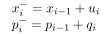 with
with  possible states, associated with a probability distribution
  that evolves over time according to the system dynamics.
The equations introduced previously apply, namely the prior estimate:
 |
(3.9) |
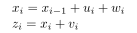 :
:
 is again a normalization factor such that
 .
.
Grid-based methods therefore make it possible to apply recursive Bayesian theory directly.
Paolo medici
