


Next: The Mahalanobis Distance Up: Elements of Probability and Previous: Sampled Gaussian
A mixture model is a mathematical formalism capable of modeling a probability distribution as the sum of parametric distributions. Mathematically,
 is the modeled distribution function,
 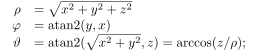 is the number of components in the model, and
  is the proportionality factor of component
  .
By definition,
.
By definition,  ,
,
 , and
, and
 .
.
 is a probability distribution parameterized by a vector (in general)
 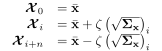 .
In Gaussian mixture models, the parameter vector consists of the mean and variance of the individual components.
.
In Gaussian mixture models, the parameter vector consists of the mean and variance of the individual components.
Mixture models are often used when  is known, can be sampled, and one only wants to determine the parameters and .
A practical example in which this formalism is used is the analysis of a population made up of distinct subpopulations.
is known, can be sampled, and one only wants to determine the parameters and .
A practical example in which this formalism is used is the analysis of a population made up of distinct subpopulations.
Paolo medici
