


Next: Homography and Conics Up: Homographic Transformations Previous: Homographic Transformations
Homography has interesting applications in several fields.
A homographic transformation generally maps lines to lines. Point-line duality also makes it possible to describe directly how line equations are transformed.
The transformation
 that maps points
 from image
  to points
  in image
  maps lines according to the dual relation:
 |
(1.118) |
Indeed, if a line  is represented by the equation
 |
(1.119) |
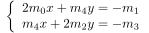 , then the corresponding line
in image must satisfy
, then the corresponding line
in image must satisfy
 |
(1.120) |
 |
(1.121) |
By examining points at infinity, it can be seen that an improper point has coordinates


 is called the line at infinity of the projective
plane and, in the representation using homogeneous coordinates, separates
proper points from improper points.
is called the line at infinity of the projective
plane and, in the representation using homogeneous coordinates, separates
proper points from improper points.
The principle of duality therefore explains how, given a transformation  (projective or homographic), the transformation that
maps a point
(projective or homographic), the transformation that
maps a point  to
to  is written as
 |
(1.122) |
 becomes
 |
(1.123) |
Paolo medici