


Next: Early Stopping Up: Generalizing Training Previous: Generalizing Training
L1 and L2 regularization consists in adding an additional term to the cost function that penalizes certain configurations.
For example, regularizing the cost function
 |
(5.124) |
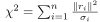 , thereby obtaining a new cost function of the form
 |
(5.125) |
 is a regularization function.
A widely used regularization function is
 |
(5.126) |
 are
are  or
or  (hence the names L1 and L2 regularization). When
  , it may also be referred to in the literature as weight decay.
These regularization functions therefore penalize parameters with excessively large values.
, it may also be referred to in the literature as weight decay.
These regularization functions therefore penalize parameters with excessively large values.