Next: Bayesian Classifiers Up: Classification Previous: Classification
A particular and very common type of classifier is the binary classifier.
In this case, the problem consists in finding a relationship linking the training set
 where
where
 is the vector collecting the information to be used for training and
 is the space of the associated classes.
Examples of intrinsically binary classifiers include:
Linear classifiers (LDA and Linear SVM) are of particular interest because, in solving the binary classification problem, they identify a hyperplane
 separating the two classes.
The equation of a hyperplane, obtained by slightly modifying formula (1.85), is
 need not have unit norm.
A hyperplane divides space into two subspaces in which equation (5.4) has opposite signs.
The separating surface is a hyperplane that divides space into two subregions representing the two categories of the binary classification.
need not have unit norm.
A hyperplane divides space into two subspaces in which equation (5.4) has opposite signs.
The separating surface is a hyperplane that divides space into two subregions representing the two categories of the binary classification.
A linear classifier is based on a discriminant function
is called the weight vector, and the term  is called the bias.
Linear classifiers are important because, through projection along the axis, they transform the problem from multidimensional to scalar.
is called the bias.
Linear classifiers are important because, through projection along the axis, they transform the problem from multidimensional to scalar.
The sign of function  represents the classification result.
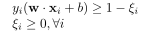
A separating hyperplane is equivalent to identifying a linear combination of the elements
represents the classification result.
A separating hyperplane is equivalent to identifying a linear combination of the elements
 such that
Paolo medici