


Next: Orthogonal Regression to a Up: Notable Regression Models Previous: Regression to a Line
When error is present along both axes (noise dependent on distance), the cost function  that maximizes the likelihood is called the Orthogonal least-squares line fit.
The error can in fact be expressed using the distance between the point and the line, according to equation (1.67).
Regression using this metric, therefore called Perpendicular Regression or Total least squares (see Section 4.2.2), is meaningful when both coordinates are affected by error, that is, when both are random variables.
The amount of noise on the two components is assumed to be equal (for the more general case, see the discussion in Section 2.4).
The error function to be minimized is the distance between the point and the line:
that maximizes the likelihood is called the Orthogonal least-squares line fit.
The error can in fact be expressed using the distance between the point and the line, according to equation (1.67).
Regression using this metric, therefore called Perpendicular Regression or Total least squares (see Section 4.2.2), is meaningful when both coordinates are affected by error, that is, when both are random variables.
The amount of noise on the two components is assumed to be equal (for the more general case, see the discussion in Section 2.4).
The error function to be minimized is the distance between the point and the line:
 .
It should be noted that, in the case of perpendicular distance, both a minimum and a maximum exist as solutions; consequently, there are two line values, orthogonal to each other, that are both solutions of the system.
.
It should be noted that, in the case of perpendicular distance, both a minimum and a maximum exist as solutions; consequently, there are two line values, orthogonal to each other, that are both solutions of the system.
From the partial derivative
 , it follows that the regression line passes through the centroid
 of the distribution, namely
 and
and  are the means of the samples
  and
and  , respectively.
Using relation (4.91), the error function (4.90) can be written as:
 ,
,
 , and
, and
 :
:
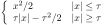 and
and  , which must be treated separately, the constraint for obtaining the minimum/maximum has the form
Finally, it should be noted that the same result is obtained much more simply by applying the SVD decomposition to the line equation. In the case of linear regression, the SVD decomposition minimizes both the algebraic and geometric errors (the algebraic and geometric errors coincide when all noise-affected terms remain confined to the constant term).
Paolo medici




