


Next: BootStrap/Sequential Importance Resampling Up: State Estimation and Bayesian Previous: Gaussian Sum Kalman Filter
The linear and quasi-linear approaches proposed by Kalman can be used for problems in which the state is Gaussian or approximately Gaussian with a unimodal distribution: the state estimate at time  is a direct function of the single state estimate at time
  and the covariance of that estimate.
When it is necessary to derive the non-Gaussian probability distribution of the system state
 at time as a function of the inputs and observations, Kalman-based approaches are no longer adequate.
Grid-based approaches are suitable for those problems, uncommon in practice, in which the state is finite and discretizable. Histogram-based/occupancy grid approaches apply to a broader class of problems, but scale very poorly as the dimensionality increases because of the uniform sampling of the state.
Consider again the result expressed by equation (2.4): to extract a generic statistic  , such as the mean or variance, from a probability distribution
  , one uses the expression
 independent samples, with
 , drawn randomly from the exact distribution
  .
.
Given the samples generated in this way, the Monte Carlo estimate of is
Monte Carlo methods do not solve every problem, nor do they indicate how to obtain random samples efficiently.
The problem becomes critical in multidimensional cases, where the regions in which the probability takes significant values are extremely small. The objective of Importance Sampling (IS) is to sample the distribution in “important” regions so as to maximize computational efficiency.
The idea behind Importance Sampling is to use a simpler distribution 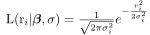 (importance density) instead of the true distribution , which is normally difficult to sample from or reproduce, making the substitution
 .
By using suitable weights, equation (3.42) can therefore be rewritten as
.
By using suitable weights, equation (3.42) can therefore be rewritten as
 is a correction weight, or importance factor (importance weight), for converting the proposal distribution
  into the true distribution .
The weights
into the true distribution .
The weights  must be normalized
 |
(3.44) |
The more similar the distribution is to , the more accurate the estimate will be.
On the other hand, the distribution must be very easy to sample from, for example by choosing a uniform or Gaussian distribution.
Given knowledge of Bayesian filters and Monte Carlo techniques, particle-filter theory can be developed.
The state at time is represented by a set of samples (particles), and each sample is a hypothesis about the state to be evaluated.
One can consider a set of particles obtained a priori to the observation by applying equation (3.43) to the state-evolution function.
If Bayesian theory is applied directly to samples from the estimated distribution, the weights  associated with the samples can be modified using the system and observation models simultaneously (Sequential Importance Sampling):
change.
When possible, it is convenient to use the prior distribution as the importance density:
 |
(3.46) |
The problem with the SIS approach is that after a few iterations only a few particles have non-negligible weights (weight degeneracy).


