


Next: Point-Line Distance Up: Lines, Planes, and Hyperplanes Previous: Line
Through two points  and
and  in Cartesian space
  passes an implicit line with equation
 denote the difference between the two points, the line passing through a point and directed along the vector has equation
 |
(1.64) |
Generalizing to the n-dimensional case, the equation of the line in
 , passing through two points
  and
and  written in homogeneous form, is the locus of points
 such that
 scalar value. The values of
  associated with values
 ![$t \in [0,1]$](img220.svg) are points internal to the segment
are points internal to the segment
 .
.
Using homogeneous coordinates, restricted to the two-dimensional Cartesian case, we obtain the following noteworthy result: the line with parameters
 , passing through points
  and
and  , is obtained as
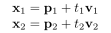 |
(1.66) |
must satisfy equation (1.62) to belong to the line.
Paolo medici

