


Next: Conditioning of the normal Up: Conditioning of linear systems Previous: Square linear systems
We now consider the case of an overdetermined system
 |
(1.37) |
Suppose that  has full column rank.
As discussed in section 1.1, the least-squares solution
can be expressed using the singular value decomposition
has full column rank.
As discussed in section 1.1, the least-squares solution
can be expressed using the singular value decomposition
 |
(1.38) |
Expanding the preceding relation gives
This expression clearly illustrates the role of the singular values.
The component of the vector  along
along
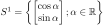 contributes to the solution in the direction
  with a factor
  . Consequently, a perturbation of the
component
. Consequently, a perturbation of the
component
 is amplified when
 assumes small values.
In this case, the condition number can be defined, in the
2-norm, as
 |
(1.41) |
 is the smallest nonzero singular value. If
tends to zero, the problem becomes increasingly sensitive
to perturbations in the data.
is the smallest nonzero singular value. If
tends to zero, the problem becomes increasingly sensitive
to perturbations in the data.
Conditioning therefore provides a geometric interpretation of the solution: directions associated with larger singular values are determined more robustly, whereas those associated with smaller singular values are determined more sensitively with respect to perturbations.
Paolo medici

